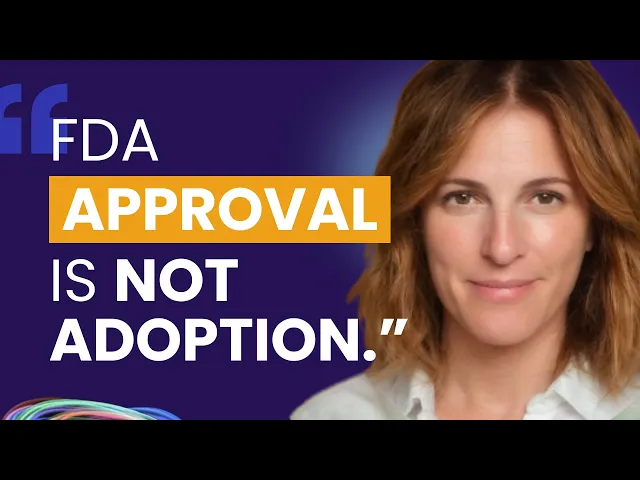
Why FDA Approval Isn’t Enough: Navigating Market Access | Lori Siegel
In this episode, I sit down with Lori Siegel to talk about what really happens after FDA approval.
Lori shares lessons from working on pre-launch commercialization in biotech, including why approval doesn’t automatically lead to adoption.
We also dig into how journey mapping and Jobs to Be Done thinking can reveal the real customer, and why reimbursement and hospital budget realities can derail even the strongest clinical story.
Three Pro Tips
Treat Commercialization as a Parallel Workstream, Not a Phase
Too many teams mentally sequence commercialization after clinical success, even when they intellectually know better. What Lori’s story reinforces is that commercialization decisions are not downstream tasks. They are design constraints. Budget impact, reimbursement mechanics, and operational feasibility quietly shape whether a product can exist in the real world at all. If these constraints are discovered late, teams are forced into reactive repositioning rather than intentional strategy.
A practical way to act on this is to run commercialization planning in parallel with pivotal trial execution. That does not mean building final messaging prematurely. It means stress testing assumptions early. Who pays first? Where does the budget actually sit? What decisions are irreversible if we wait? Treating commercialization as a living system rather than a milestone dramatically reduces late stage surprise. Early commercial readiness assessments and go-to-market risk audits are just two of the ways you can accomplish this.
Separate Clinical Value from Operational Permission
A subtle but critical insight from Lori’s story is that agreement does not equal permission. Clinicians may believe in the therapy. Payers may acknowledge long-term value. Yet operational permission, the ability to actually deploy the product, can still be missing. That permission often lives with pharmacy leadership, pharmacy and therapeutics committees, and operational workflows that rarely appear in early go-to-market plans.
Teams should explicitly ask: Who grants operational permission, and what do they require to say yes? This shifts strategy from persuasion to enablement. Evidence packages, packaging decisions, and deployment models should be built around removing friction for these gatekeepers, not just convincing end users.
Build Your Expert Bench Before You Think You Need It
One of the quiet throughlines of this episode is how often progress came from who Lori’s team spoke with, not just what they analyzed internally. Hospital leaders, reimbursement experts, and experienced operators surfaced constraints no spreadsheet could reveal. The mistake many teams make is not ignorance. It is waiting too long to ask.
A practical rule of thumb: if a decision could materially delay launch, you should already know someone who has navigated it before.
Follow Bill: / founderandcdo
Contact Bill: https://meshagency.com/lets-connect/
Video Podcast: / @billschickfcmo
Audio Podcast: https://www.buzzsprout.com/2380430
Follow Lori: / lori-siegel-mph